Slow Down to Rise Up: How Fermentation and Lamination Unlock Extraordinary Pastry Flavor
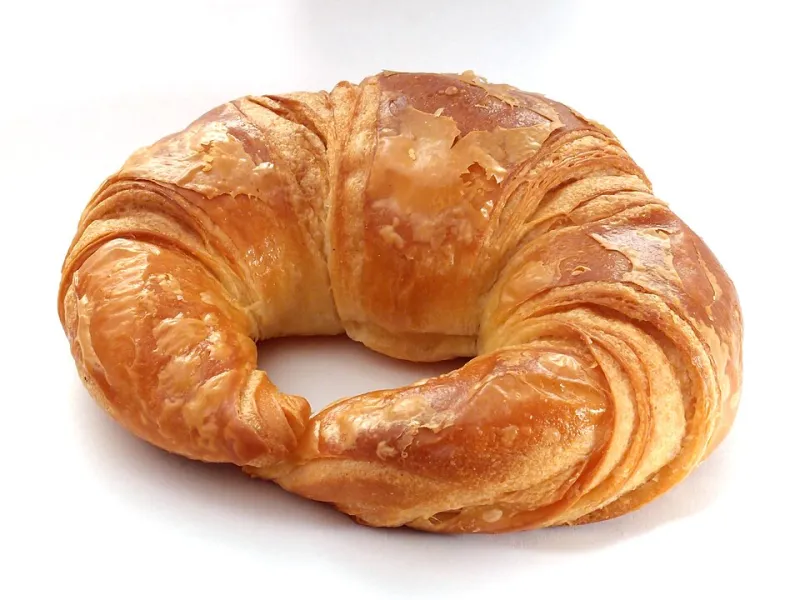
Photo: SKopp, CC BY-SA 3.0, via Wikimedia Commons
There is a quiet revolution unfolding in American home kitchens. Where speed and convenience once reigned, a growing community of dedicated bakers is choosing a different path — one measured not in minutes but in hours, sometimes days. They are discovering what European boulangeries have long understood: that the most extraordinary pastries are not produced quickly. They are cultivated.
Two techniques lie at the heart of this philosophy — fermentation and lamination. Separately, each is a craft unto itself. Together, they create pastries of breathtaking complexity that no commercial shortcut can replicate.
The Living Dough: Why Fermentation Is More Than Rising Time
Fermentation is, at its most fundamental, a biological process. Wild yeasts and beneficial bacteria consume the sugars present in flour, producing carbon dioxide for lift and a cascade of organic acids and aromatic compounds that define flavor. But most American baking recipes treat fermentation as a formality — a single rise of sixty to ninety minutes before the oven. This abbreviated timeline leaves the majority of flavor potential entirely unrealized.
Extended cold fermentation, by contrast, allows doughs to develop over twelve to seventy-two hours in a refrigerator. The lower temperature slows yeast activity dramatically, permitting enzymes within the flour to break down starches and proteins at a more measured pace. The result is a dough with a nuanced, slightly tangy profile, a more open crumb structure, and a depth of flavor that a rushed dough simply cannot achieve.
"When I first switched to an overnight levain for our morning pastries, the difference was immediate," says Margaux Ellison, head pastry chef at a boutique café in Portland, Oregon. "Customers started asking what we were doing differently. The flavor had this complexity — almost nutty, with a gentle acidity — that people couldn't quite place but absolutely loved."
For home bakers, transitioning to extended fermentation requires little more than planning ahead and trusting the process. A straightforward starting point is to prepare your dough the evening before baking, allow it to proof at room temperature for thirty minutes, then transfer it to the refrigerator overnight. The following morning, the dough will have developed considerably more character than its quick-rise counterpart.
The Architecture of Layers: Understanding Lamination
If fermentation is the soul of an artisan pastry, lamination is its structure. The technique involves folding a thin sheet of cold butter repeatedly into a supple dough, creating alternating layers that, when exposed to oven heat, produce the shattering, honeyed crispness of a well-made croissant or kouign-amann.
The science is deceptively elegant. Water within the butter converts to steam during baking, physically separating the dough layers and creating the characteristic flakiness prized in laminated pastries. The fat itself shortens the gluten strands between layers, preventing them from fusing back together. The interplay between these forces — steam, fat, and gluten — determines whether a pastry emerges from the oven as a masterpiece of tender, distinct layers or a dense, undifferentiated mass.
Temperature is the single most critical variable in successful lamination. Both the dough and the butter must remain cold enough to prevent the fat from melting into the dough, yet pliable enough to fold without cracking. Professional pastry chefs often work in temperature-controlled environments; home bakers must compensate through diligence, resting the dough in the refrigerator between each fold.
"The mistake I see most often is impatience," explains Daniel Tran, owner of a small-batch pastry studio in Austin, Texas. "People skip the rest periods because they want to finish the process. But those rests are when the gluten relaxes and the butter firms back up. Without them, you're just pressing layers together rather than building them."
A standard lamination for croissant dough involves three to four letter folds, each separated by a thirty-minute chill. This patience yields the dramatic honeycomb interior that is the hallmark of a properly laminated pastry — a visual testament to the care invested in its construction.
When Fermentation and Lamination Converge
The true artistry emerges when these two techniques are applied in sequence. Many accomplished pastry chefs now incorporate a pre-ferment — a poolish or levain — into their laminated doughs, introducing microbial complexity before a single fold is made. The fermented component contributes subtle acidity that not only enhances flavor but also strengthens the gluten network, making the dough more extensible and better able to hold the delicate layers created during lamination.
The result is a croissant or Danish pastry with a flavor profile that unfolds in stages: the initial crunch of caramelized exterior layers, the yielding tenderness of the interior, and a lingering, gently sour finish that invites another bite.
"It's about building flavor the way a composer builds a piece of music," says Ellison. "Each technique adds its own voice. Fermentation is the bass note — foundational, warm, complex. Lamination is the melody — bright, structural, dramatic. Neither is complete without the other."
Practical Steps for the American Home Baker
Beginning this journey does not require professional equipment or a temperature-controlled kitchen. It requires, above all, a willingness to reorganize one's relationship with time.
Start with a poolish. Before making any laminated dough, prepare a simple pre-ferment by combining equal parts flour and water with a small amount of yeast — as little as one-eighth teaspoon — and allowing it to ferment at room temperature for eight to twelve hours. Incorporate this into your dough recipe in place of a portion of the flour and water, and notice the immediate improvement in aroma and flavor.
Invest in a quality butter. European-style butters with a higher fat content — eighty-two to eighty-four percent — are significantly better suited to lamination than standard American butter. Brands such as Plugrá or Kerrygold are widely available across the United States and will produce noticeably superior results.
Respect the cold. If at any point during lamination your dough begins to feel soft or greasy, stop immediately, wrap it, and refrigerate it for at least thirty minutes before continuing. There is no shortcut here that does not compromise the final product.
Embrace the timeline. Plan your laminated, long-ferment pastry project across two days. Prepare the dough and pre-ferment on the first day; complete the lamination and baking on the second. This rhythm, once established, becomes second nature.
The pastries that emerge from this unhurried process are unlike anything produced through conventional methods. They carry within them the evidence of care — in their shattering layers, their golden color, their complex, lingering taste. For those willing to slow down, the reward is a pastry that genuinely rivals the finest European boulangeries, made in an American kitchen, by an American baker, one patient fold at a time.