Cold, Slow, and Deliberate: The Art of Infusing Pastry Fillings with Cold-Brewed Tea

There is a particular frustration familiar to any baker who has attempted to weave tea into a pastry filling using conventional hot-brewing methods. The resulting cream or curd often carries an unexpected sharpness — a vegetal edge or a drying bitterness that overwhelms the delicate, floral, or grassy notes one was originally trying to capture. The culprit, in nearly every case, is heat.
Across the country, from boutique bakeries in Portland to pastry counters in New York's West Village, a more considered approach is gaining quiet momentum. Pastry chefs are turning to cold extraction — the same slow-steep philosophy that transformed the American coffee scene — and discovering that it unlocks an entirely different dimension of tea's flavor potential. The result is a generation of fillings, custards, and creams that taste unmistakably of the leaf, without a trace of astringency.
Why Heat Is the Enemy of Subtlety
To understand why cold brewing matters, one must first consider what happens when tea meets boiling water. Heat accelerates the release of every soluble compound in the leaf simultaneously: the desirable aromatic oils and amino acids, yes, but also the tannins and catechins responsible for bitterness and the drying sensation that coats the palate. For a cup of tea consumed on its own, this balance is manageable and, to many, pleasurable. For a pastry filling, however, where those compounds must coexist with butter, egg yolk, sugar, and cream, the bitterness becomes amplified rather than tempered.
Cold extraction operates on an entirely different principle. When tea leaves steep in cold water or cold dairy over an extended period — typically between eight and twenty-four hours — the lower temperature selectively draws out volatile aromatic compounds and amino acids while leaving the majority of tannins and catechins behind, still bound within the leaf's cellular structure. The resulting concentrate is smooth, rounded, and intensely flavored in the most refined sense. It carries the personality of the tea without any of its harsher tendencies.
Building a Cold-Brew Tea Concentrate for Pastry
The technique itself is admirably straightforward, though it rewards patience and precision. The choice of liquid matters considerably. For most custard-based applications — crème pâtissière, diplomat cream, or a classic tart curd — cold whole milk or heavy cream serves as the extraction medium, effectively pre-infusing the dairy before it ever touches heat. For lighter fillings or glazes, filtered cold water produces a cleaner concentrate that can be reduced or incorporated without adding additional fat.
A reliable base method:
- Measure your tea at a ratio of approximately one tablespoon of loose-leaf tea per four ounces of cold liquid. For more assertive results, particularly with delicate white teas or high-grade Japanese greens, increase to one and a half tablespoons.
- Combine the tea and liquid in a sealed glass container or jar. Avoid reactive metals, which can introduce off-flavors during extended contact.
- Refrigerate for a minimum of eight hours. For a more concentrated, complex result, allow twelve to sixteen hours. Taste at intervals; the extraction is complete when the flavor is vivid but smooth.
- Strain through a fine-mesh sieve, pressing the leaves gently to release the last of the infused liquid without forcing bitterness.
- Use immediately, or refrigerate the concentrate for up to three days.
This cold-infused dairy or water then becomes the building block for virtually any filling in your repertoire.
Applications Across the Pastry Kitchen
Croissant Fillings and Laminated Pastry
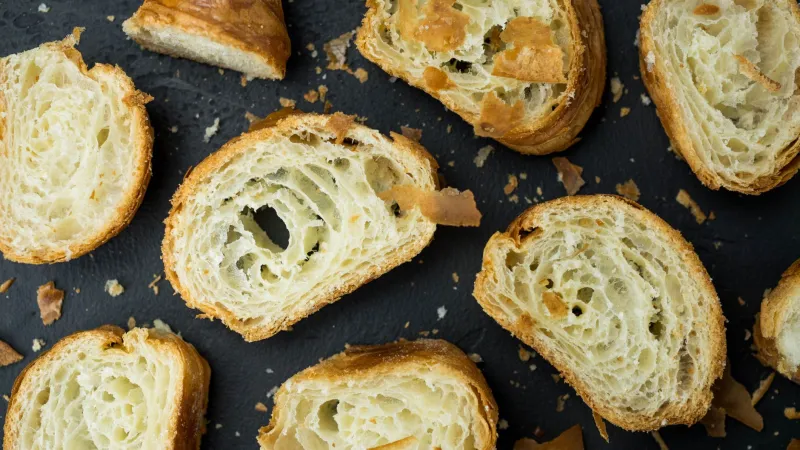
Few pairings feel as natural as a cold-brewed Darjeeling first flush steeped into a lightly sweetened almond cream, or frangipane, piped into croissants before their final bake. The aromatic muscatel notes of a quality Darjeeling — notes that hot brewing can easily scorch into bitterness — survive the cold extraction intact and carry beautifully through the oven's heat when protected within the fat-rich almond paste. Earl Grey cold-brewed into heavy cream and then incorporated into a croissant diplomat filling is equally compelling; the bergamot remains bright and citrus-forward rather than soapy, as it can become when hot-brewed at high temperatures.
Tarts and Custard Fillings
For tart applications, the cold-brew concentrate integrates seamlessly into crème brûlée or crème pâtissière bases. A Japanese hojicha — the roasted green tea with its warming, caramel-like character — cold-brewed in whole milk and used as the dairy base for a classic vanilla pastry cream produces a filling of extraordinary depth. The nuttiness of the roasted leaf reads as complexity rather than bitterness, and the result pairs magnificently with a buttery pâte sucrée shell and fresh seasonal fruit.
Matcha enthusiasts will find that cold extraction, while unconventional for a powdered tea, still applies when working with whole-leaf green teas that share matcha's flavor profile. Gyokuro, steeped cold in cream for sixteen hours, delivers the same umami-rich, oceanic sweetness that makes matcha so coveted in pastry, without the risk of color degradation that often accompanies high-heat preparation.
Éclairs and Choux Pastry
The éclair is perhaps the ideal canvas for cold-brewed tea fillings, given the neutrality of the choux shell and the prominence of its cream. A cold-brewed silver needle white tea — among the most delicate and florally complex of all teas — steeped in heavy cream and then whipped into a Chantilly or folded into a mousse produces a filling of remarkable lightness. The honeydew and white peach notes characteristic of a quality silver needle come through with a clarity that would be impossible to achieve through hot brewing. Paired with a light honey glaze on the éclair's surface, the result is a study in restraint and elegance.
Guidance for the Home Baker
Those approaching this technique for the first time are encouraged to begin with a tea whose flavor they know intimately — one they have brewed and enjoyed in the cup. Cold extraction will deliver a truer, cleaner version of that flavor than any hot brew, which makes familiarity with the source material an advantage. Start with a single application: cold-brew a first flush Darjeeling into heavy cream, whip it lightly with a small quantity of sugar, and serve it alongside a simple fruit tart. The difference from a conventionally prepared cream will be immediately apparent.
From there, the technique scales naturally. Keep detailed notes on steep times, ratios, and the specific teas used, as the variables interact differently with each cultivar and processing style. A heavily oxidized Assam may require only eight hours before its concentration becomes overwhelming, while a lightly oxidized oolong might benefit from the full twenty-four.
A Technique Worth Adopting
Cold-brew infusion for pastry fillings is not a shortcut, nor is it a novelty. It is, rather, a logical extension of the care that already defines artisan baking — a recognition that the finest ingredients deserve extraction methods calibrated to their character. When the goal is a cream or custard that speaks clearly and beautifully of the tea within it, patience and cold water will always outperform speed and the kettle.