When the Air Itself Becomes the Enemy: Protecting Laminated Pastry from Humidity
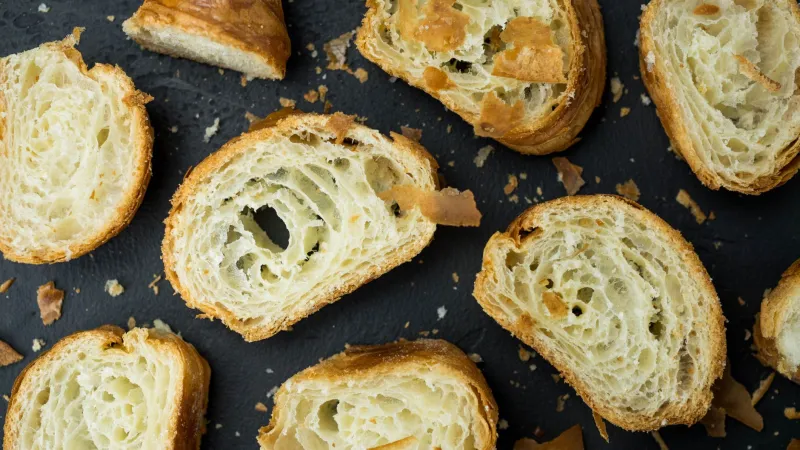
There is a particular cruelty to the moment a beautifully laminated croissant — one that emerged from the oven shattering with crispness and audible with promise — surrenders its structure within an hour of being set on the counter. No fault of technique. No error in the lamination. The butter was cold, the folds precise, the proof unhurried. The culprit, invisible and entirely indifferent to your efforts, was the air itself.
Humidity is the silent variable that professional pastry kitchens and refined tea rooms have spent decades learning to manage. For home bakers across the United States — contending with the swampy summers of the Gulf Coast, the arid winters of the Mountain West, or the unpredictable shoulder seasons of the Mid-Atlantic — understanding how atmospheric moisture interacts with laminated dough is not an academic exercise. It is the difference between pastry that commands reverence and pastry that merely satisfies.
Why Laminated Dough Is Uniquely Vulnerable
To appreciate the threat humidity poses, one must first understand what lamination actually accomplishes. When butter is folded repeatedly into a détrempe — the initial dough — it creates dozens, sometimes hundreds, of alternating layers of fat and gluten. During baking, the water content within those fat layers converts to steam, forcing the layers apart in a dramatic, irreversible expansion. The result is the characteristic open, airy crumb and the shattering exterior crust that defines croissants, kouign-amann, and pains au chocolat at their finest.
The structural integrity of this achievement depends entirely on those fat layers remaining discrete — separated, uncompromised, and impermeable to moisture migration. Once a laminated pastry exits the oven and begins to cool, it enters a period of genuine vulnerability. The crisp exterior, formed by the rapid dehydration of surface starches and the caramelization of sugars, is microscopically porous. Ambient moisture finds those pores immediately.
When relative humidity climbs above approximately 60 percent — a threshold routinely exceeded throughout the American South and Midwest during summer months — the surface starches begin to reabsorb water vapor from the surrounding air. The crust softens. The layers, no longer reinforced by that dry, rigid exterior, begin to compress under their own weight. Within two hours, what was once architectural becomes merely dense.
What Tea Rooms Have Always Known
The finest afternoon tea establishments in the United States — from historic hotels in San Francisco to boutique tea rooms in Charleston and Boston — have long treated humidity control as a non-negotiable element of service. This is not incidental. The presentation of scones, mille-feuille, and other laminated confections alongside delicate teas demands that both elements arrive at the table in peak condition.
Professional tea service environments typically maintain relative humidity between 45 and 55 percent, a range that preserves pastry texture without creating the dry, throat-catching atmosphere that would compromise the aromatic complexity of fine teas. Climate control in these spaces is calibrated not merely for human comfort but for the preservation of layered, moisture-sensitive foods.
There is also a lesser-known consideration: the teas themselves. Many premium loose-leaf teas — particularly high-grade white teas, certain oolongs, and aged pu-erh — are hygroscopic, meaning they actively absorb moisture from their surroundings. When stored improperly in high-humidity environments, these teas lose aromatic volatility and develop a flat, muted character. The same atmospheric conditions that degrade a croissant's crust are quietly diminishing the complexity of the teas meant to accompany it. A well-appointed tea room understands that managing the environment is, in fact, managing the entire experience.
The American Climate Challenge
Unlike the relatively temperate conditions of many European baking traditions, the American home baker must contend with dramatic regional and seasonal variation. A baker in Phoenix, Arizona, faces ambient humidity levels that can drop below 20 percent in winter, causing laminated doughs to dry too rapidly during proofing and develop surface cracking before they ever reach the oven. Conversely, a baker in New Orleans in July may struggle with relative humidity exceeding 80 percent, where simply resting dough on the counter for fifteen minutes invites premature softening of the butter layers.
These are not edge cases. They are the everyday reality of baking across a continent-sized country, and they demand adaptive strategies rather than rigid adherence to recipes developed in controlled professional environments.
Practical Strategies for the Home Baker
Invest in a hygrometer. Before addressing humidity, one must measure it. Inexpensive digital hygrometers — widely available at hardware stores and online retailers — provide real-time readings of relative humidity in your kitchen. Knowledge of your specific conditions is the prerequisite for every strategy that follows.
Chill aggressively in high-humidity environments. In humid climates, laminated doughs benefit from more frequent and longer refrigeration rests between folds. This is not merely about keeping the butter cold; it is about preventing the dough's surface from absorbing ambient moisture during the lamination process. A covered, chilled dough is a protected one.
Time your bake strategically. In regions with pronounced seasonal humidity, early morning baking — before outdoor temperatures peak and before cooking and dishwashing have added moisture to indoor air — can meaningfully improve results. Running the kitchen exhaust fan throughout the process also helps evacuate steam generated by any concurrent cooking.
Use a dehumidifier during proofing. A small, portable dehumidifier positioned near your proofing area can maintain a more stable environment, particularly during summer months in humid regions. This is a modest investment that yields disproportionate returns for the serious home baker.
Serve immediately, or store with intention. Laminated pastry is designed for immediacy. When same-day service is not possible, storage in a paper bag — never plastic, which traps moisture — placed in a cool, dry environment extends structural integrity far better than refrigeration, which introduces condensation upon removal.
Re-crisp with dry heat. A five-minute rest in a 350°F oven, uncovered, will restore much of the surface crispness lost to humidity. This is standard practice in professional tea service kitchens, where pastries are often finished to order rather than presented cold from a display case.
The Tea Pairing Consideration
For those who approach pastry as one half of a composed experience — as the editorial philosophy of this publication invites — humidity management extends naturally to tea storage. Premium loose-leaf teas should be housed in airtight, opaque containers, well away from the steam produced during baking. A beautifully laminated morning bun paired with a properly stored first-flush Darjeeling represents the full realization of what a mindful baker and tea enthusiast can achieve. Allowing both to suffer from the same atmospheric neglect squanders that potential entirely.
The relationship between environment and excellence in both baking and tea is not a peripheral concern for the perfectionist. It is, in many respects, the foundation upon which everything else rests. The baker who masters humidity has not merely solved a technical problem — they have begun to think like a professional, with the same quiet attentiveness to invisible variables that distinguishes extraordinary craft from competent execution.